Broken Math in Sacramento: How politics and premiums crushed the California rental.
Soaring interest rates, 50% insurance spikes, and rent control caps are freezing out individual housing investors while politicians claim to solve affordability.


🗺️ Current Dispatch: Capital City Freeway, Sacramento, California
⛽ Local Diesel: $4.85/gal
☕ Diner Coffee Index: $4.25 — black, scalding, served in a heavy ceramic mug near the state capitol. 7/10.
⏳ Days in trip: 29
Hi from sunny Sacramento — let’s dive into the broken math of real estate.
My wife and I have spent the past several months trying to find a viable investment residential property across Northern California. What we’ve run into isn’t a lack of inventory or a shortage of motivation. We’ve run into broken math.
Between soaring interest rates, rising maintenance costs, sky-high home values, and shifting political rules, it has become nearly impossible for an independent investor to buy a single-family home and make the numbers pencil out.
Politicians in Sacramento and Washington like to parade in front of television cameras, claiming they are saving the housing market by targeting investors. But their policy sledgehammers don’t distinguish between multi-billion-dollar Wall Street private equity funds and mom-and-pop buyers trying to build long-term family wealth.
The net result? The middle-class investor gets locked out, housing inventory stays constricted, and the fundamental supply crisis gets worse.
Sponsored by Frontieras North America
The “Rockefeller Moment” For Coal
In the 1800s, John D. Rockefeller started refining oil into the world’s most valuable fuel. Now, another innovator is creating its own “Rockefeller Moment” with one of the world’s most abundant energy resources: coal.
Using their patented FASForm technology, Frontieras North America can transform coal into high-value commodities like hydrogen, diesel, jet fuel, and fertilizer, without burning it.
Reaching just 2% of the global coal market could mean a trillion-dollar valuation for Frontieras.
Institutional investors are already moving. Frontieras has secured a $150 million investment commitment from GEM and raised over $30 million from private investors.
NASDAQ ticker reserved: Frontieras has officially reserved the “FASF” ticker, a major step toward a public listing.
Real-world infrastructure: Frontieras just broke ground on their $850 million flagship facility in Mason County, West Virginia.
Become a Frontieras shareholder by August 6 to lock in the $9.01 share price.
The Unvarnished Math: Running the Numbers in Sacramento
Let’s strip away the broker hype and run the cold, hard spreadsheet realities facing anyone attempting to buy an investment property in the Sacramento market today.
Consider a standard, middle-tier three-bedroom single-family home in the Sacramento metropolitan area. That property currently commands a purchase price of around $500,000.
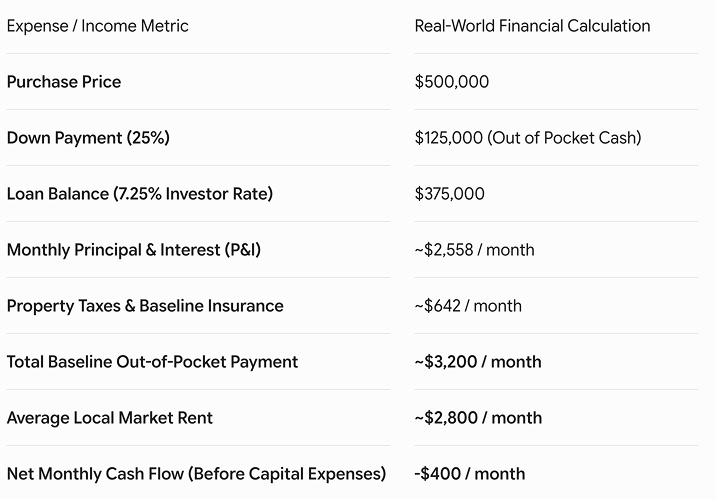
Look at those numbers closely.
Even after writing a check for $125,000 in liquid cash for a 25% down payment—far more than standard primary buyers put down—and securing a balance at current 7.25% investor mortgage rates, your monthly out-of-pocket carrying cost lands at roughly $3,200 a month.
Meanwhile, the prevailing local market rent for that three-bedroom home tops out around $2,800 a month.
You are paying $400 a month out of your own pocket just for the privilege of owning a home that someone else lives in. And that -$400 negative cash flow doesn’t even account for:
- Local property tax reassessments or special municipal bonds.
- Homeowners Association (HOA) monthly dues.
- Capital expenditure reserves (roof replacement, HVAC failures, plumbing emergencies).
- Tenant vacancy windows and turnover painting/cleaning costs.
Just a few short years ago, the equation worked. I own a local rental property that pencils out, but only barely—and strictly because I purchased it when mortgage rates were sitting comfortably in the 2% range. If that loan were refinanced at today’s rates, the asset would instantly flip into a cash-draining liability.
The Political Target: Ban the Buyer, Ignore the Root Cause
California legislators and federal policymakers have increasingly turned single-family housing investors into political scapegoats.
With landmark federal bills like the 21st Century ROAD to Housing Act taking aim at large institutional buyers, and California state legislators continually introducing bans on corporate rental ownership, the political narrative insists that removing investors will magically make homes cheap for first-time buyers.
Here is the flaw in their logic: Corporations and cash-rich individuals are currently the only entities capable of swallowing these broken metrics.
When a home requires $125,000 in cash down just to run a negative monthly yield, working-class first-time buyers relying on 3.5% FHA loans stand zero chance. High interest rates have effectively frozen entry-level buyers out of the market. By simultaneously villainizing independent housing investors, state authorities are cutting off the very private capital that buys, renovates, and maintains the rental housing stock that millions of workforce families rely on.
“When central planners mandate pricing caps and suppress yields while interest rates remain elevated, private capital doesn’t suddenly accept lower returns—it simply stops building and buying.”
The Insurance Shockwave: The Hidden Margin Killer
If elevated interest rates were the initial gut punch to real estate arithmetic, the ongoing California home insurance crisis is the decisive blow.
Over the past few years, major insurance carriers have repeatedly paused new policy writing, canceled existing coverage across entire zip codes, or filed for double-digit rate increases. Landlords across the state are getting crushed by non-renewal notices driven by satellite roof scans and regional wildfire risk models, forcing thousands onto the state’s last-resort FAIR Plan at rates up to three times higher than traditional coverage.
On the local rental I still operate, my property insurance premium shot up by 50 percent in a single year.
That single line-item escalation left me with a brutal decision:
- Pass the entire premium increase directly onto my tenant through higher monthly rent.
- Absorb the spike myself and operate the asset at a net loss.
Because California enforces statewide rent-control parameters under laws like AB 1482—capping annual rent increases at 5% plus local CPI (up to a strict 10% maximum)—landlords operate inside a financial vice. While state law caps the gross revenue a property owner can collect, it places absolutely no caps on rising property insurance premiums, municipal utility rate spikes, trade labor costs, or material inflation.
Even if an owner qualifies for an exemption from state rent control, there is a human reality on the other side of the lease. Most independent landlords aren’t faceless conglomerates operating out of offshore trusts; we deal directly with our tenants. Raising rent by several hundred dollars a month to offset insurance hikes places severe financial strain on good tenants who have their own rising household bills to manage.
When property owners are forced to choose between pricing out reliable tenants or absorbing operational losses on assets they risk their own capital to maintain, the business model breaks down entirely.
The Macro Extraction: Why Crushing Investors Hurts Renters Most
Let’s step back and look at the broader economic landscape through the windshield.
When politicians make real estate investing unviable for independent individuals:
- Rental Inventory Contracts: Small landlords sell off single-family rentals to owner-occupiers, directly shrinking the total pool of available long-term rental housing.
- Rents Spike Higher: Less available rental supply creates fiercer competition among tenants, driving open-market rents higher for remaining units.
- Maintenance Suffers: Operating on paper-thin or negative margins forces property owners to defer routine maintenance, lowering overall housing quality across local neighborhoods.
The idea that penalizing landlords leads to lower housing costs is a complete policy delusion. Housing affordability is driven by raw supply and demand. Until California drastically cuts red tape, reduces zoning friction, and encourages rampant new home construction, short-sighted political interventions will continue to destroy the very math required to house the population.
The Roadside Execution
If you’re looking to deploy capital in today’s market, stop chasing marginal, cash-flow-negative single-family residential deals in high-friction states.
Until regional insurance markets stabilize and regulatory hostility cools down, paper returns in strict rent-controlled corridors are an illusion. Focus on real, hard assets, guard your liquid capital, and avoid buying into broken financial models just because real estate worked five years ago.
Keep your eyes on the road, hold your ground, and stay out of the corporate white noise.
— Brook
The Bare Economy. From the road. For the road.
U.S. Government Digital Dollar Plan
We have urgent news…
The U.S. government is moving forward with the Central Bank Digital Currency (CBDC) — and this may be your final opportunity to protect your cash and privacy.
Once this system is in place, the government will have full control over your money. They’ll decide what you can buy… how much you can spend… and they’ll be able to track every transaction you make.
There’s still time to legally “opt out” before the Digital Dollar becomes mandatory.
Click here now to get your FREE copy before it’s taken down.
Don’t wait — every day you delay gives the government more power over your money.
CLICK HERE TO CLAIM YOUR GUIDE NOW
(ad)
This is a paid advertisement for Frontieras’s Regulation A offering. Please read the offering circular at
https://invest.frontieras.com/
Reservation of the ticker symbol is not a guarantee that we will be listed on the NASDAQ. Listing on the NASDAQ is subject to approvals.Under Regulation A, a company may change its share price by up to 20% without requalifying the offering with the Securities and Exchange Commission.Sources* The global market for our products is worth a combined value of over $2.1 trillionhttps://www.globenewswire.com/en/news-release/2022/03/24/2409228/0/en/Global-Diesel-Market-Size-To-Surpass-US-1269-87-Billion-By-2027-Europe-Having-Share-About-25-Leading-Players-Strategies-Covid-19-Outbreak-Growth-Opportunities-Emerging-Trends-Segme.htmlhttps://www.marketsandmarkets.com/Market-Reports/hydrogen-market-132975342.html#:~:text=The%20global%20hydrogen%20market%20in,7.8%25%20from%202023%20to%202030https://www.transparencymarketresearch.com/naphtha-market.htmlhttps://www.fortunebusinessinsights.com/industry-reports/aviation-fuel-market-100427https://www.marketresearchfuture.com/reports/anthracite-market-2742https://www.precedenceresearch.com/fertilizer-market#:~:text=According%20to%20precedence%20research%2C%20the,USD%20271.6%20billion%20by%202032