Sun Belt Office Towers, Shrinking Beer Cans, and the Real Inflation Nobody's Tracking
I tracked diesel, diner eggs, and brewery closures across 400 miles of Texas this week.

Already at home - Austin
🗺️ Current Dispatch: South Congress Avenue, Austin, Texas
⛽ Local Diesel: $3.87/gal
☕ Diner Coffee Index: $3.40 (Waffle House, Humble exit — burnt, honest, no apologies)
⏳ Days in trip: 0
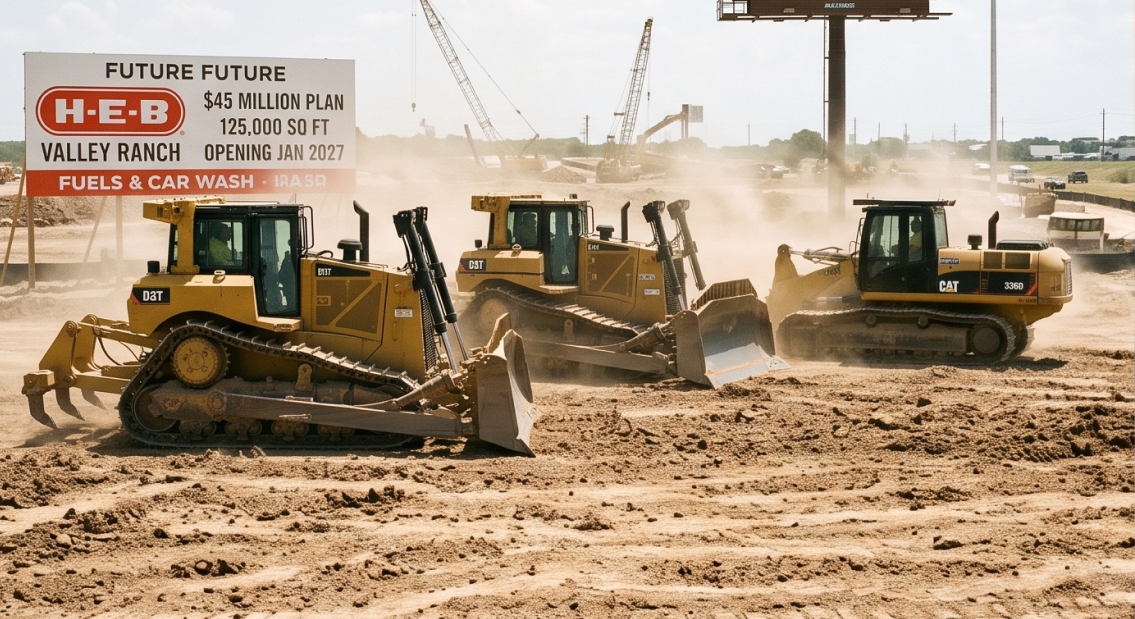
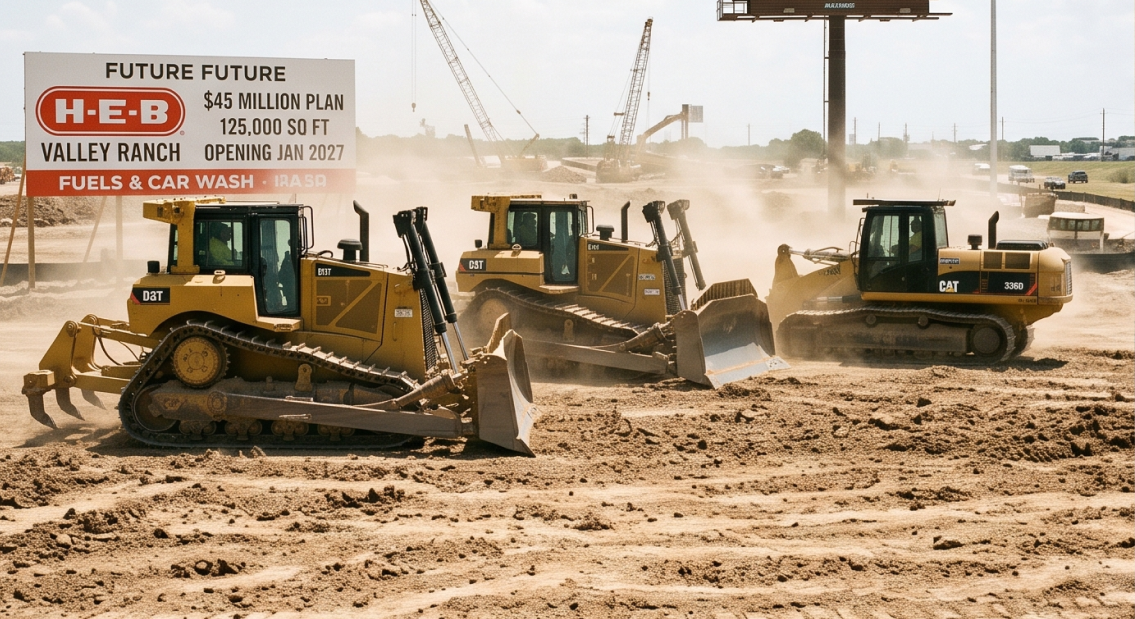
I’m idling at a truck stop where the Grand Parkway bends north past New Caney. A huge dirt lot is being scraped flat by three Caterpillars. They’re moving in sync. That kind of order means deep pockets just wrote a big check.
That somebody is H-E-B. They filed a $45 million plan for a 125,000-square-foot grocery store here. Car wash. Fuel station. The works. This town barely showed on a map five years ago. Build starts January 2027. They’re calling it H-E-B Valley Ranch.
If you know H-E-B, you know they don’t build on hope. They build where the math is settled.
I watched the dozers work for twenty minutes. Drank my bad coffee. And I kept chewing on something that’s nagged me for 400 miles of Texas road.
It’s this: brand-new premium builds and the mass die-off of small business are happening in the same zip codes. Same towns. Same exits.
This week’s dispatch is about that split. The growing gap between premium and everything else. And I’m going to tell it through the strangest lead signal I’ve found yet — the shrinking beer can.
The Pony Beer Index: When They Shrink the Can, They’re Telling You Everything
Let me set the scene before I get clinical.
Two days ago I pulled into a gas station outside Dripping Springs. It’s one of those Hill Country towns now catching Austin’s million-dollar home spillover. Per Unlock MLS data, 729 homes sold above $1 million in Austin from January to May this year. In the same window in 2019? Just 262. The overflow is pouring into Wimberley, Dripping Springs, Spicewood. Money moving outward like a blast wave.
I grabbed a six-pack from the cooler. Except it wasn’t a six-pack. It was eight tiny 7-ounce “Pony” cans — Sierra Nevada. Price: $11.99. I stood there doing per-ounce math on my phone like a crazed clerk.
Here’s the deal. The Wall Street Journal reported July 2nd that big U.S. beer makers are pushing small “Pony” beer lines hard — 7 to 9 ounce cans. About half a normal pour. Sierra Nevada. Constellation Brands (Corona). They call it a “wellness” play. They cite GLP-1 drugs and younger folks drinking less.
Sounds smart. Sounds like progress.
It’s not. It’s shrinkflation in a wellness costume.
U.S. beer shipments fell 1.6% in the first four months of 2026 versus last year, per Bump Williams Consulting. Craft beer output dropped 4% in 2025. Sixty percent of breweries saw declines, per the Brewers Association. California alone lost nearly 50 craft breweries in two years. Down from 987 to 939.
This isn’t just an American story. In the UK, 137 indie breweries closed in 2025. Just 1,578 remain. Camra — the Campaign for Real Ale — wants a government probe. Why? Because 80% of UK beer now comes from foreign giants. In 1990, 96% of UK brewing was British-owned. Four global players crushed that. One campaigner said they “brew nothing worth exporting.”
Ballast Point — the San Diego brewery that once sold for $1 billion — just shut its San Francisco brewpub in Mission Bay. Fort Point and HenHouse merged. Oakland’s Temescal filed Chapter 11.
Meanwhile in Russia, the biggest brewers formed a council. Their goal: cut hop imports to 50% by 2030. Kill aluminum can imports entirely. Even Moscow reads supply chain signals faster than most U.S. craft shops.
Mark, Carol — the Pony can is your inflation decoder ring. Less product. More cost per ounce. They call it a lifestyle choice. That’s not a beer trend. That’s the whole consumer economy in a 7-ounce aluminum tube.
Premium or Perish: The Sun Belt Split and the 11% Kill Zone
Now zoom out from the beer cooler to the skyline.
I drove through downtown Houston yesterday. The office tower story tells the same tale as the brewery story — just with more zeros.
Forbes reported July 3rd that Sun Belt office vacancy runs 12% to 18%. But that headline number is a lie. Inside it hides a brutal split. Tenants are fleeing Class A and B buildings. They’re piling into Class A+ trophy towers. In Austin, despite ugly overall vacancy, The Republic — an 830,000-square-foot Class A+ tower — preleased nearly 400,000 square feet.
The rent gap says it all. Median asking rents: Class A+ at $62 per square foot. Class A at $27. Class C at $20. That’s not a market. That’s a caste system.
Class A listings sit for a median of 251 days. Class B? 319 days. Class C is dead stock in cities like Charlotte, Dallas, Phoenix, and San Antonio.
Same pattern as beer. Georgetown Brewing in Seattle just bought a $10.2 million building to expand — while 60% of craft breweries shrank. Premium brands with clear positioning eat. Everyone else files papers.
The small business closure data proves this is structural. Not cyclical. National Tax Service stats show 976,000 businesses closed in 2025. Overall closure rate: 8.64%. But in the six sectors where small shops cluster — manufacturing, wholesale, retail, food service, lodging, and services — the rate hit 11.08%. Retail closures ran at 15.40%. Food service at 15.14%. “Business slump” was cited by 55.7% of closures in those sectors.
Even legacy spots that lasted decades are falling. Last year, 41,659 restaurants open for more than five years closed. That’s the highest count on record. Restaurants open over 20 years? 2,797 shut down. A 61% jump in four years.
This isn’t a recession. It’s a sorting. The economy is splitting into two tiers: premium survivors and everything below the waterline.
The Laptop Execution & The Roadside Detour
So where do you park capital when the economy runs a premium-or-perish filter on every sector?
You follow the H-E-B model. Deploy into assets where the math is already settled. Not hope. Math.
The $15 Gold Fund That Pays Up to $1,152/Month (ad)
Physical gold stays the bedrock shield. When they shrink beer cans and call it progress — when 11% of small businesses in core sectors die each year — you want metal. Metal that needs no business plan. No lease renewal. Non-custodial. In your hands. Outside the kill zone.
On the equity side, I’m watching plays tied to real building — firms building where people are moving. The Grand Parkway corridor north of Houston is a live case study. H-E-B doesn’t guess. When they drop $45 million on a store in New Caney, they’ve already counted rooftops through 2035.
Trail stop discipline matters. Premium assets hold. Everything below premium is in free fall. If you hold commercial REIT weight in Class B and C office, the Forbes data is yelling at you. Get out. Or get filed with the dead stock.
Slow trades. Hard assets. Premium picks. That’s the playbook when the middle vanishes.
The Roadside Detour:
One last thing. Driving through New Caney, I passed a hand-painted sign on a fence post. It read: “LIVE CRAWFISH — ALSO NOTARY PUBLIC.” Same spot. Same person.
I pulled over. Asked the woman running it how business was. She looked at me like I was simple. Said, “Honey, everybody’s either eating or signing something they wish they hadn’t.”
That’s the whole American economy in one line. I wrote it on a napkin. Taped it to the dash.
Transmission ends. Diesel’s burning. Northbound.
— Brook
The Bare Economy. From the road. For the road.
The institutional “Paper Trail” is public
While headlines focus on China and Iran… the smart money is moving.
Recent 13F filings show that institutional giants like BlackRock and Morgan Stanley have already started accumulating shares.
They are moving into one small company tied to a newly confirmed U.S. resource discovery.
This isn't speculation—it is a matter of public record.
After 20 years of mapping, the U.S. Extended Continental Shelf Task Force just confirmed access to massive undersea minerals.
These are the same metals—Nickel, Cobalt, and Manganese—that China currently controls.
Most retail investors haven't looked at the federal filings yet.
That's why this asset is still significantly mispriced.
Get the ticker before the institutional "accumulation phase" ends.
See the filings and the ticker symbol here >>
(ad)