The Iron Mission: Cold steel, brutal winters, and the birth of Cedar City.
North Las Vegas just opened 4,262 acres to developers. I drove the perimeter.

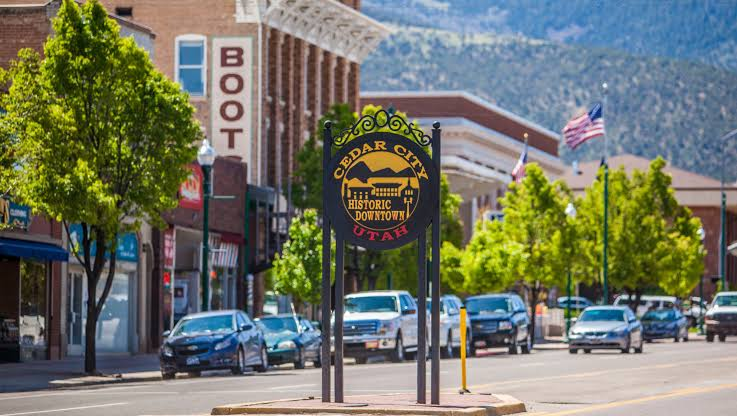
🗺️ Current Dispatch: Main Street, Cedar City, Utah
⛽ Local Diesel: $3.95/gal
☕ RV-Stove Coffee: $3.25 — strong, black, served in a heavy stoneware mug near the tracks. 8/10.
⏳ Days in trip: 22
I’ve pulled the rig off I-15 and parked it in the shade near Coal Creek. Up on the surrounding plateaus, the wind is howling through the pinion and juniper.
Most folks speeding through Iron County on their way to Zion or Bryce Canyon see Cedar City as a convenient pit stop for gas and a hot meal. They don’t realize that 170 years ago, this very patch of dirt was chosen to be the industrial engine of the entire American West.
When the Mormon pioneers pushed into the Great Basin in 1847, they hit a hard wall: they had zero industrial independence. Every nail, spade, wagon tire, and plowshare had to be hauled thousands of miles across the plains by ox team. Brigham Young knew that paper promises and fiat currency wouldn’t build a self-sustaining territory. You need hard assets. You need steel.
In late 1850, word reached Salt Lake City that massive, high-grade iron ore deposits were sitting out in the open in Southern Utah. Young didn’t write a policy paper; he issued a direct “Iron Mission” call to roughly 120 frontiersmen and skilled ironworkers—many of them recent immigrants from the industrial foundries of the British Isles. Their directive: head south, find the ore, build a blast furnace, and manufacture industrial self-reliance from scratch.
The Driver’s Scene: The Mouth of Coal Creek
I took a walk down to the old furnace sites near the mouth of the canyon.
By November 1851, those pioneers established Fort Cedar. They picked this spot because it offered the holy trinity of 19th-century heavy industry: high-grade iron ore at Iron Springs, dense forests for charcoal, and water power paired with raw coal deposits tucked right up Coal Creek Canyon.
Think about the sheer, brutal physical reality of what those men faced. They didn’t have heavy excavators or rail lines. They hauled raw, heavy ore by ox-drawn wagons over frozen mud, hand-quarried limestone, and built a hand-cut stone blast furnace on the banks of a wild creek.
By September 1852, against all odds, they tapped the furnace and poured the first pig iron manufactured west of the Mississippi. It was a monumental victory of raw human sweat over extreme environment.
The Wi-Fi Portfolio: Native Product Placements & Market Signals
- AI & Compute Infrastructure (The New Frontier): While pioneers struggled with raw charcoal, today’s compute grid runs on autonomous power networks. Watch high-density data centers retrofitting the mountain west grid to power next-gen AI inference pipelines. Real intelligence requires cold, local power generation.
- Pre-IPO Aerospace & Space Tickers (Autonomous Capital): As legacy ground supply chains fracture, defense and orbital hardware are shifting toward rapid-launch private space platforms. Keep allocations in off-grid telecom and launch-infrastructure platforms that operate independently of legacy logistics bottlenecks.
- Physical Gold (The Asset Shield): The Deseret Iron Company proved that fiat paper collapses when localized trade networks freeze. Hold physical, non-custodial gold as your ultimate financial shield while central banks try to paper over systemic energy inflation.
In partnership with Immersed
What does 75,000 on a waitlist mean for a private company?

75,000 people are waiting.
For a headset that ships later this year.

The Visor is Immersed's work-focused AR/VR headset. Lighter than a smartphone. Higher resolution. Significantly more affordable.
75,000+ people are on the waitlist right now. Before the product ships. Not because of an ad campaign, because the software behind it already has 1.5M daily users and a 4.3-star rating.
Immersed built the audience first. Then the hardware. Then the AI on top.
The round is open now at $0.79/share.


Disclaimer: Immersed is offering securities through the use of an Offering Statement that has been qualified by the Securities and Exchange Commission under Tier II of Regulation A. The valuation is set by the Company and there is currently no public market for the Company's Common Stock. Please read the offering circular and related risks at invest.immersed.com. Nasdaq ticker “IMRS” has been reserved by Immersed and any potential listing is subject to future regulatory approval and market conditions.
The Macro Extraction: The Price of Heavy Supply Chains
Here is the cold, unvarnished truth about the Iron Mission: Nature eventually forced a shutdown.
The project was plagued by a brutal series of supply chain shocks:
- Severe Environment: Flash floods repeatedly tore down the canyon, washing away diversion dams and inundating furnace foundations built on spongy creek soil.
- Resource Bottlenecks: The local coal was choked with sulfur, making it nearly impossible to smelt high-quality, malleable iron consistently without cracking the castings.
- Crop Failure & Starvation: Extreme freezing temperatures and localized crop shortages forced the colony to abandon the foundries for months at a time just to farm enough grain to survive the winter.
By 1858, facing mounting financial losses and regional geopolitical tension, Brigham Young officially suggested the blast furnaces be abandoned. The corporate investment failed. The Deseret Iron Company closed its doors.
Cedar City’s population collapsed as workers scattered to other settlements.
Feds just made it official — GOLD in 401(k)s/ IRAs
(ad)
The Roadside Detour: What Stays Real When the Furnace Dies
Before I fire up the rig and head west toward the Nevada line, here is the real lesson from Cedar City.
If you look at a spreadsheet from 1860, the Iron Mission was a total financial loss. But the physical infrastructure and the human resilience stayed behind. The roads carved into the canyons, the agricultural irrigation lines, and the stubborn family roots established during that brutal decade laid the permanent foundation for Iron County. Decades later, commercial rail lines finally arrived, and large-scale iron mining thrived on the exact grounds those early pioneers mapped out.
Paper speculation and short-term financial plays burn out when the environment gets tough. But real, physical infrastructure—and the grit to build it—outlasts every economic collapse.
Keep your eye on the real assets, hold your ground, and stay out of the corporate white noise.
— Brook
The Bare Economy. From the road. For the road.
Elon’s Most Ambitious Project Yet?
Take a look at this image.
You're looking at a 114-acre site on the Tennessee-Mississippi state line...
What's being built here could be the most ambitious project of Elon Musk's career.
One of the only media outlets allowed inside the closely guarded facility called what they saw "absolutely amazing."
Nvidia's CEO called it "Superhuman"
And White House AI Czar David Sacks says "Elon is scaling this faster than anyone."
Meanwhile, competitors are so desperate to figure out what's going on... they've resorted to flying spy planes over the complex.
This is bigger than Tesla and SpaceX...
So big that a Nobel Prize winning scientist says it "could have an even greater impact on society than the internet and mobile technology."
And I believe it's about to trigger a 70X investment boom.
I've pinpointed three stocks at the center of it all.
Click here and I'll give you the full details — including the name and ticker of my #1 pick.
(ad)